 Latest reviews
 Latest blog posts




LaserPecker U1: The Glass-Engraving Promise—and What Buyers Still Need to Know
The new LaserPecker U1 promises easier glass and crystal engraving. Its 5W and 10W UV versions are interesting—but the missing specifications matter as much as the demo. Here is our buyer-focused announcement preview.
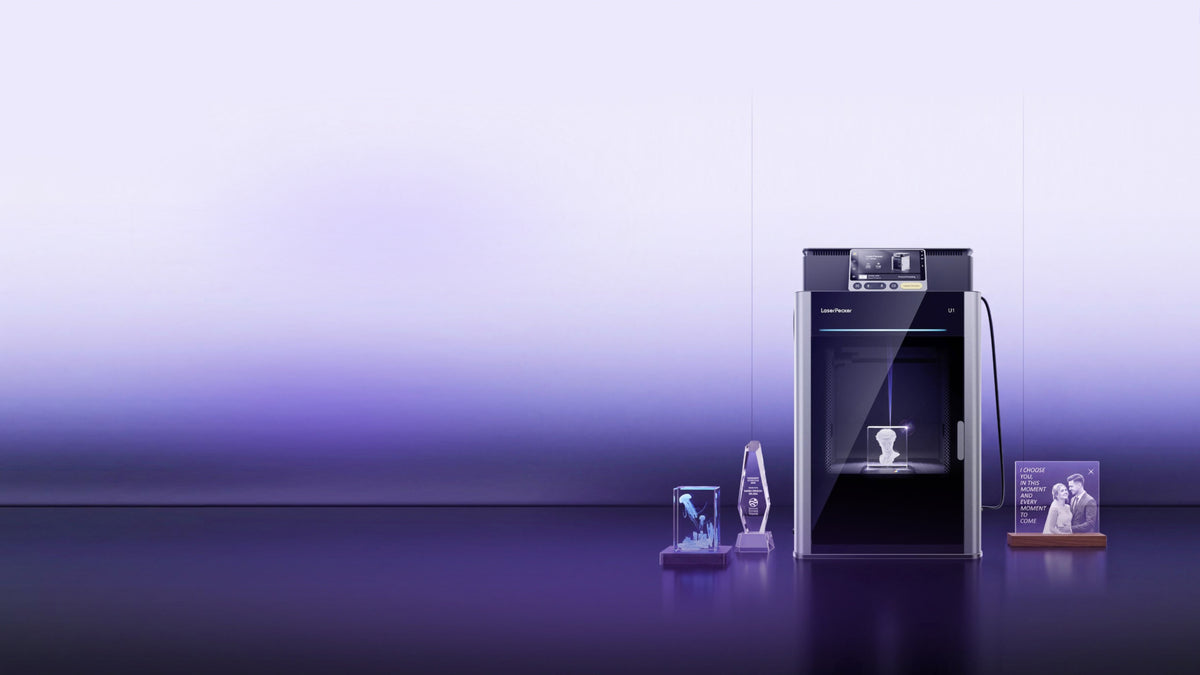
A beautiful engraved crystal is the easy part of a product launch to admire. For a small workshop, the harder questions come afterward: how long does each job take, how many pieces fail, and can the operator repeat the result tomorrow?
That is the useful way to approach the LaserPecker U1, a newly announced UV engraver aimed at glass and crystal personalization. This is a source-based preview, checked on September 18, 2026, not a hands-on review. We have not tested a U1 or measured its output.
What has actually been announced?
LaserPecker introduced the U1 at IFA 2026 with 5W and 10W UV configurations. Its announcement describes transparent-material autofocus, automatic surface mapping and focal adjustment, and a lens that can cover both internal and surface engraving. Lens recognition is intended to load the correct parameters after a change. The manufacturer also states Class 1 safety and expects availability through its website in Q4 2026. Glass cutting is specifically claimed for the 10W version. These are manufacturer statements, not our test findings. Read the original announcement.
The IFA exhibitor page confirms LaserPecker’s presence at the September 4–8 show. A trade-show appearance is useful evidence of an announcement; it does not establish retail availability or production reliability.
5W or 10W: choose a job before choosing watts
| Question | 5W UV | 10W UV |
|---|---|---|
| Announced configuration | Yes | Yes |
| Glass-cutting claim in the announcement | Not specifically established | Manufacturer claim |
| Verified retail price | Not available in our checks | Not available in our checks |
| Independent same-job speed comparison | Not established | Not established |
Our advice is to start with a representative product: perhaps a crystal award, a glass sign or a personalized gift. Request the same design on the same blank from each configuration. Compare total preparation time, engraving time, cleanup, visible defects and rejected pieces. A nominal power difference alone is not a business case, and no upgrade path between versions has been confirmed.
A particularly important request is a close-up of the finished surface or cut edge. A distant promotional photograph cannot answer whether the result meets your customers’ quality expectations. Ask for the original design and processing settings too, so the demonstration is reproducible rather than just attractive.
The missing specifications are the buying checklist
We could not confirm the U1’s working area, object-height clearance, engraving speed, weight or exact wavelength from the reviewed official sources. Nor did those sources settle model-specific operating systems, connections or LightBurn compatibility. Contemporaneous launch coverage also identifies substantial specification gaps.
Software check: the official LDS download page and firmware compatibility table identify supported machines but do not list the U1. LDS being available for Windows and macOS does not establish U1 support. We therefore record compatibility as unconfirmed, not unsupported, and have not linked the U1 to LDS or LightBurn as a supported device.
Before ordering, ask for:

- Usable geometry: the surface field, internal engraving volume, maximum object size and access needed for fixtures.
- Material evidence: the precise glass composition and thickness used for any cutting claim, including passes and edge quality.
- Complete software workflow: supported OS versions, file formats, offline operation, subscriptions and which features work in third-party software.
- Total ownership cost: delivered price, required lenses and fixtures, extraction, consumables and regional service arrangements.
These are questions to resolve, not a list of features we claim the U1 includes. In particular, compatibility on another LaserPecker machine should not be copied onto this one.
Availability: a campaign teaser is not a price
The German official page currently promotes an upcoming Kickstarter campaign and mentions a refundable deposit. We did not verify a purchasable U1 machine in the existing US, EU or German LaserPecker Shopify catalogs. An Amazon Germany search surfaced other LaserPecker models, but no U1 ASIN we could validate.
Consequently, our listing has no invented offer, placeholder price or imported ASIN from a different machine. Treat Q4 as the manufacturer’s expected availability window, not a guaranteed delivery date. Before paying any deposit, distinguish the reservation terms from the eventual machine purchase and check what the full package contains.
Safety and evidence still matter
The manufacturer’s Class 1 statement is not a guarantee of emission-free or unattended operation. We have not independently checked the final U1 safety documentation. Plan around the final manual, appropriate extraction and approved materials. General MIT laser-cutter guidance emphasizes supervision and keeping safety interlocks intact.
We also found no verified customer-rating set or independent production-unit test that would justify a numerical score. Early coverage should help you form questions, not substitute for answers from finished hardware.
Our verdict: worth a shortlist, too early for a best-buy badge
The interesting question is whether the U1 makes a difficult glass or crystal job reliably repeatable for your workshop. That would be more useful than another impressive demonstration. For now, shortlist it if those are the products you want to make; do not assume it is the right general-purpose cutter or commit to customer delivery dates around an estimated launch.
See our LaserPecker U1 listing for the linked 5W and 10W variants, the known facts and the explicit gaps. The next meaningful buying evidence will be final specifications, real regional offers and repeatable material tests—not an assumed price or a borrowed specification.